

How AI Development Companies in India Are Fueling the Next Wave of Innovation

How AI Development Companies in India Are Fueling the Next Wave of Innovation

In today’s rapidly evolving tech landscape, partnering with an AI development company in India has become essential for businesses looking to innovate and scale efficiently. With top AI developers in India offering advanced artificial intelligence development services, organizations are using AI to automate operations, enhance decision-making, and deliver personalized customer experiences.

India’s tech scene just keeps getting bigger. Some of the best AI companies out there are based here, rolling out solutions for healthcare, finance, retail, logistics, education—you name it.

Why Do So Many Businesses Pick AI Companies in India?

  1. Top-Notch Talent

India’s got a deep pool of AI talent. Developers here know their stuff—machine learning, NLP, computer vision—and they use that know-how to build systems that really think and learn.

  1. Quality Work That Doesn’t Break the Bank

You don’t have to choose between cost and quality. Indian AI companies offer solid development at prices that make sense, so you get real value without cutting corners on innovation or deadlines.

  1. AI That Grows With You

Need something custom? No problem. The best AI teams in India design models that fit your needs and keep up as your business changes. They automate, analyze, and enhance—whatever it takes to move you forward.

  1. Fast Tech Adoption

India’s tech community moves fast. Whether it’s generative AI, deep learning, or the latest in automation, Indian developers jump on new tech early and make sure their clients stay competitive worldwide.

Where Indian AI Developers Are Making a Difference

Healthcare

AI is flipping the script on healthcare. Indian developers are building algorithms that sift through medical data and help doctors make quicker, smarter calls.

Finance

Banks and fintech startups count on Indian AI companies for everything from fraud detection to credit scoring and personalized investment advice.

Retail and E-Commerce

In retail, AI developers in India are behind smarter recommendations, sharper customer insights, and smoother inventory management. The result? Shopping that feels personal and efficient.

Manufacturing

Predictive maintenance, robotics, and process improvements—AI is giving manufacturers fewer headaches and more productivity.

What’s Next for AI Development in India?

The demand’s only going up. India’s mix of skilled pros, a drive to innovate, and cost-effective services makes it a go-to spot for AI. Whether you’re a new startup or a big player, teaming up with a seasoned Indian AI company can speed up your digital transformation and keep you ahead.

The Bottom Line

AI development companies in India are shaking up entire industries and opening doors to all kinds of new possibilities. They’re not just building software—they’re helping shape the future of tech here and around the world. Heading into 2025, expect India’s AI experts to keep delivering smart, scalable, and game-changing solutions for businesses everywhere.
The Difference Between AI | Machine Learning and Deep Learning

The Difference Between AI, Machine Learning, and Deep Learning

Artificial Intelligence (AI) has become one of the most talked-about topics in technology today. From self-driving cars and voice assistants to personalized recommendations on streaming platforms, AI is powering innovations that touch almost every part of our lives. But while the term AI is often used as a catch-all, it’s important to understand the distinctions between Artificial Intelligence (AI)Machine Learning (ML), and Deep Learning (DL).

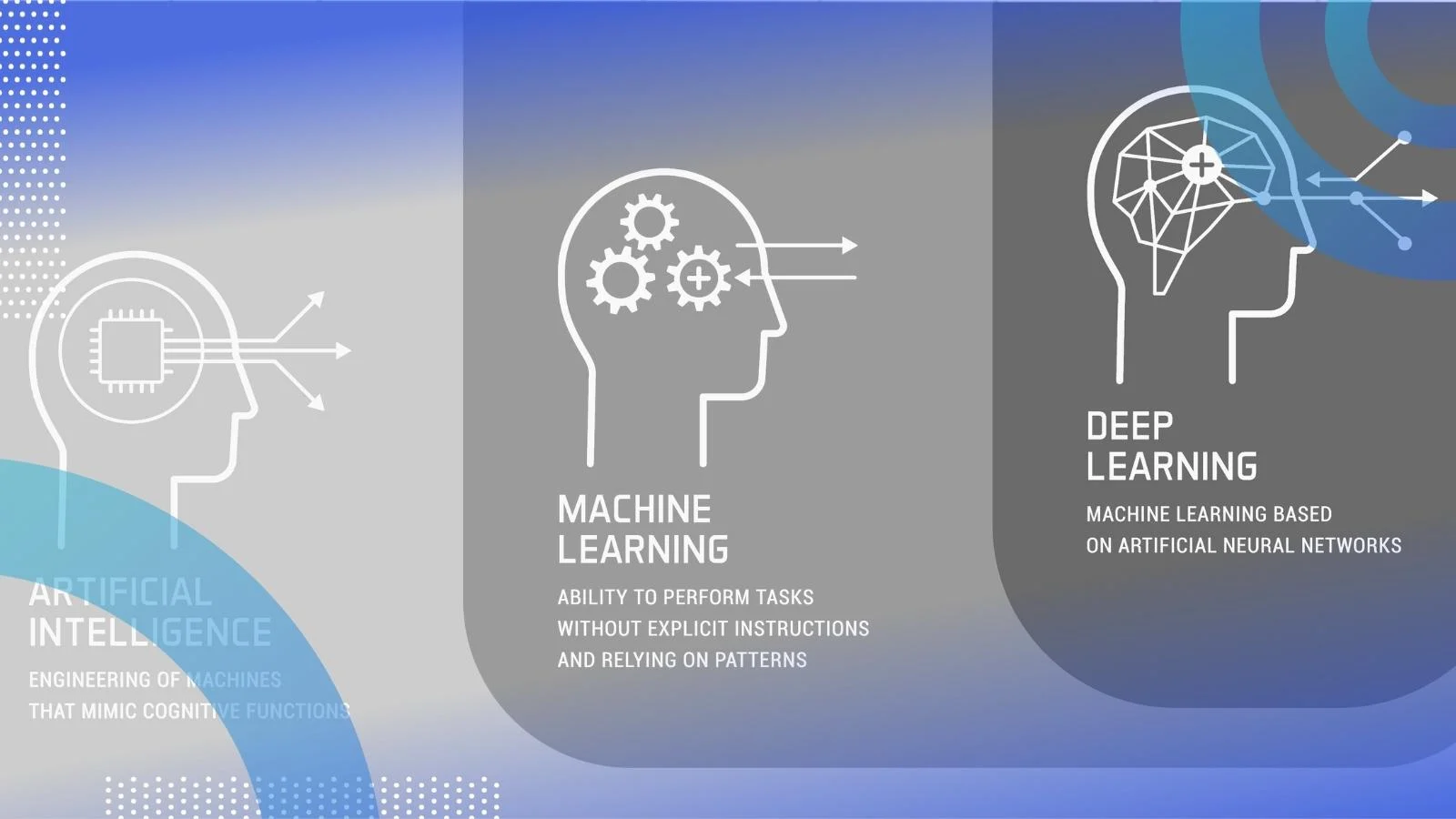
These three terms are related, but they don’t mean the same thing. Think of them as layers of a hierarchy—where AI is the broad concept, ML is a subset of AI, and DL is a further subset of ML. Let’s break it down.


1. Artificial Intelligence (AI): The Big Picture

Artificial Intelligence refers to the broad field of computer science focused on building systems capable of performing tasks that typically require human intelligence. These tasks include reasoning, problem-solving, learning, perception, and even creativity.

AI can be classified into two main types:

  • Narrow AI (Weak AI): AI systems designed to perform a specific task, such as language translation or playing chess. Examples include Siri, Alexa, and Google Maps.
  • General AI (Strong AI): A theoretical form of AI that could perform any intellectual task a human can do. This is still in the realm of research and speculation.

Key Characteristics of AI:

  • Mimics human intelligence.
  • Can be rule-based (without learning from data).
  • Covers a wide range of applications, from robotics to natural language processing.

Example: An AI-powered chatbot programmed to answer questions using predefined rules and limited decision-making.


2. Machine Learning (ML): Teaching Machines from Data

Machine Learning is a subset of AI focused on enabling machines to learn from data and improve their performance over time without being explicitly programmed. Instead of writing rules manually, developers feed ML algorithms with data, and the system identifies patterns to make predictions or decisions.

Types of Machine Learning:

  1. Supervised Learning: Algorithms learn from labeled datasets (input-output pairs). Example: Predicting house prices based on features like location and size.
  2. Unsupervised Learning: Algorithms work with unlabeled data to find hidden patterns. Example: Customer segmentation in marketing.
  3. Reinforcement Learning: Algorithms learn by interacting with an environment and receiving feedback in the form of rewards or penalties. Example: Training robots to walk.

Key Characteristics of ML:

  • Relies on data-driven models.
  • Focuses on prediction and pattern recognition.
  • Requires less human intervention once trained.

Example: Netflix recommending shows based on your viewing history.


3. Deep Learning (DL): Inspired by the Human Brain

Deep Learning is a subset of machine learning that uses artificial neural networks to mimic the way the human brain processes information. These networks have multiple layers (hence the term “deep”) that allow them to learn complex patterns in large datasets.

Deep learning has been responsible for some of the most impressive breakthroughs in AI, such as image recognition, speech recognition, and natural language understanding.

Key Characteristics of DL:

  • Uses neural networks with multiple layers.
  • Requires massive amounts of data and computational power.
  • Excels at tasks like computer vision, voice assistants, and autonomous driving.

Example: A self-driving car detecting pedestrians, traffic signals, and other vehicles using deep neural networks.


4. The Relationship Between AI, ML, and DL

Here’s a simple way to visualize their relationship:

  • AI is the umbrella term—the overall concept of creating smart machines.
  • ML is a subset of AI that allows systems to learn from data.
  • DL is a further subset of ML that uses advanced neural networks for more complex tasks.

Think of it like this:

  • AI = The entire universe of intelligent systems.
  • ML = A planet within that universe, where data-driven learning happens.
  • DL = A continent on that planet, specialized in solving highly complex problems using neural networks.

5. Real-World Examples to Illustrate the Difference

  • AI Example: A chess program that follows hardcoded rules to beat human players.
  • ML Example: Spam filters that improve over time by learning from emails marked as spam or not spam.
  • DL Example: Google Photos automatically recognizing faces and grouping them together.

6. Why Does This Distinction Matter?

Understanding the difference between AI, ML, and DL is crucial for businesses, professionals, and everyday users because:

  • It helps set realistic expectations about what technology can and cannot do.
  • It clarifies what resources (data, computing power, expertise) are needed for different solutions.
  • It avoids confusion when discussing trends, capabilities, and future directions in tech.

Conclusion

Artificial Intelligence, Machine Learning, and Deep Learning are deeply connected, but they’re not interchangeable terms. AI is the big idea, aiming to make machines act intelligently. ML is one way to achieve AI, by letting machines learn from data. DL takes ML further, using complex neural networks to solve tasks once thought impossible for machines.

As technology advances, these fields will continue to overlap, evolve, and fuel innovations that shape the future of how we live and work.

The Playbook of the Future: How Generative AI is Changing Sports

The Playbook of the Future: How Generative AI is Changing Sports

For decades, the sports world has relied on analytics to gain an edge. Coaches and analysts poured over statistical data and video clips, searching for patterns and tendencies. But a new era is dawning. Generative AI, a transformative technology capable of creating entirely new content and insights, is moving beyond simple analysis to actively invent new plays, simulate scenarios, and create personalized training environments. It’s the difference between studying history and creating the future.

The AI-Generated Playbook: From Data to Creation

Traditional sports analytics have always been about understanding what happened. Generative AI, however, takes that understanding and uses it to construct something that has never existed before. By ingesting petabytes of game footage, player biometric data, and historical team strategies, these models learn the fundamental “rules” of a sport. They can identify the subtle movements of a defender, the optimal angle for a pass, and the precise moment to make a cut.

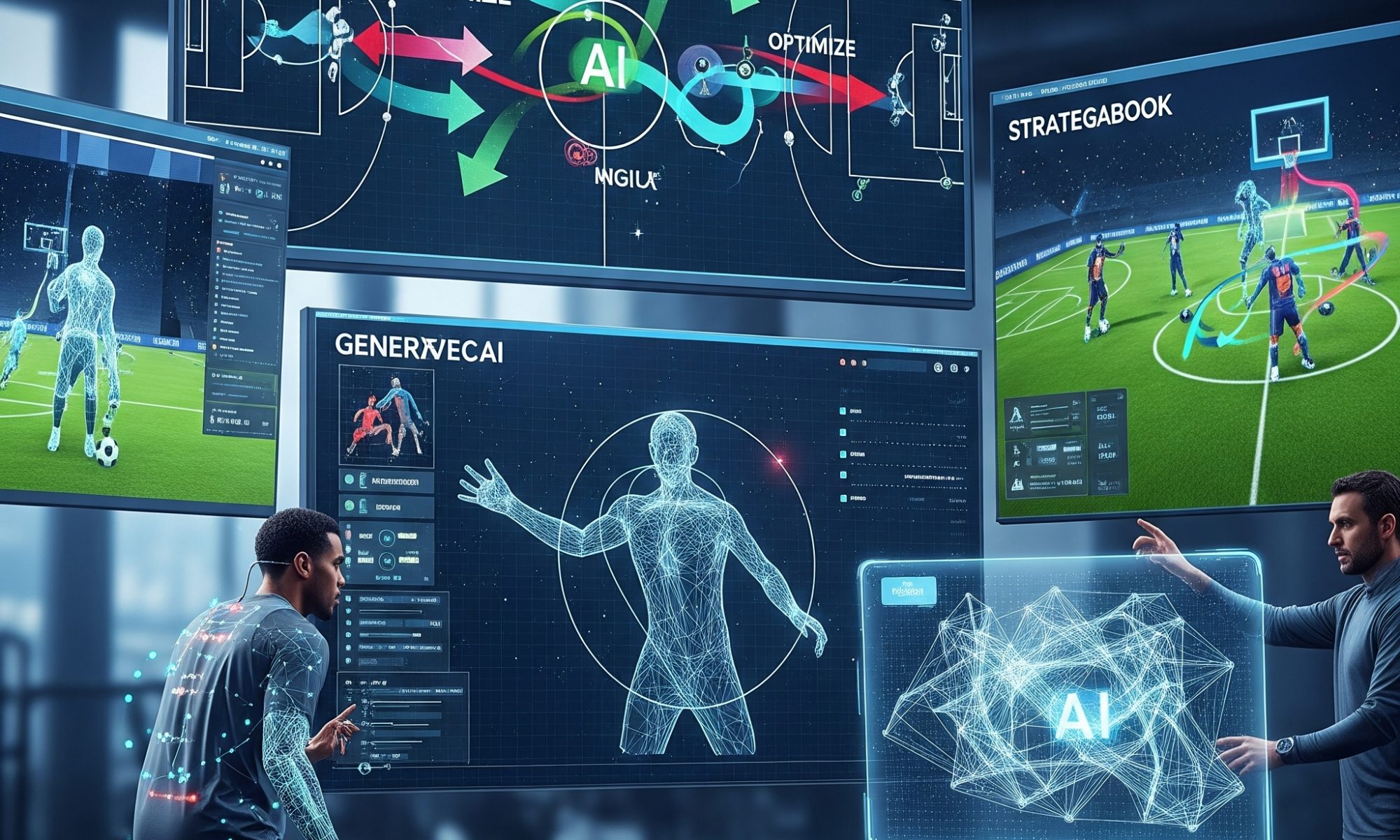
With this knowledge, a coach can pose a specific challenge: “Generate a new offensive play to score from the 20-yard line against a 4-3 defense with a zone blitz.” The AI won’t just pull a play from a database; it will synthesize a new one, complete with detailed player routes, timing adjustments, and even alternative options based on the defense’s response. This capability allows teams to surprise opponents with fresh, unpredictable strategies, ensuring they are always innovating and never stagnating.

The Digital Twin Opponent: Practice Against Perfection

One of the most powerful applications of generative AI is the creation of a “digital twin.” This is a hyper-realistic virtual replica of an opposing player, an entire team, or even a coach’s tactical philosophy. Unlike a simple video simulation, this digital twin learns and adapts. It can mimic an opponent’s individual habits, like a quarterback’s pre-snap reads or a striker’s preferred dribbling direction.

This allows athletes to train against a virtual version of their next opponent that is as dynamic and unpredictable as the real thing. A basketball team can run drills against a digital twin of an opposing squad, practicing their offense against that team’s specific pick-and-roll coverage and defensive rotations. The AI learns from each interaction, refining the digital twin’s behavior to provide a training experience that is both challenging and hyper-relevant.

Hyper-Personalized Training in VR

Beyond team strategy, Generative AI is tailoring training down to the individual athlete. VR training environments, once simple and static, are now being powered by AI to become truly interactive. The AI can analyze a player’s biomechanical data from wearable sensors and then generate a workout that addresses their specific weaknesses.

For example, a pitcher struggling with control could enter a VR environment where the AI generates thousands of unique batting scenarios, each one designed to test their accuracy under pressure. If the AI detects a slight change in the pitcher’s arm angle—a potential precursor to injury—it can immediately adjust the drill, providing real-time feedback and corrective guidance. This level of personalized, adaptive training maximizes performance gains while simultaneously minimizing the risk of injury, all without the physical strain of an in-person practice.

A New Frontier in Scouting and Talent Identification

The impact of generative AI also extends to talent acquisition. For years, scouting has been a mix of data and intuition. Generative AI is now providing a third dimension: a predictive capability. By analyzing a potential recruit’s college or amateur game data, the AI can simulate how they would perform in a professional system. It can generate “what-if” scenarios, such as how a player’s stats might change if they were paired with a different teammate or if they had a heavier workload. This helps scouts and GMs make more objective, data-driven decisions and uncovers hidden gems in lower-profile leagues who might have been overlooked by traditional methods.

In conclusion, Generative AI is ushering in a new age of sports. From crafting innovative game plans and creating perfect practice partners to building customized training regimens and revolutionizing scouting, this technology is providing a powerful, creative engine for teams and athletes alike. The future of sports will be defined not just by talent and hard work, but by the intelligence of the system that helps them prepare and perform.