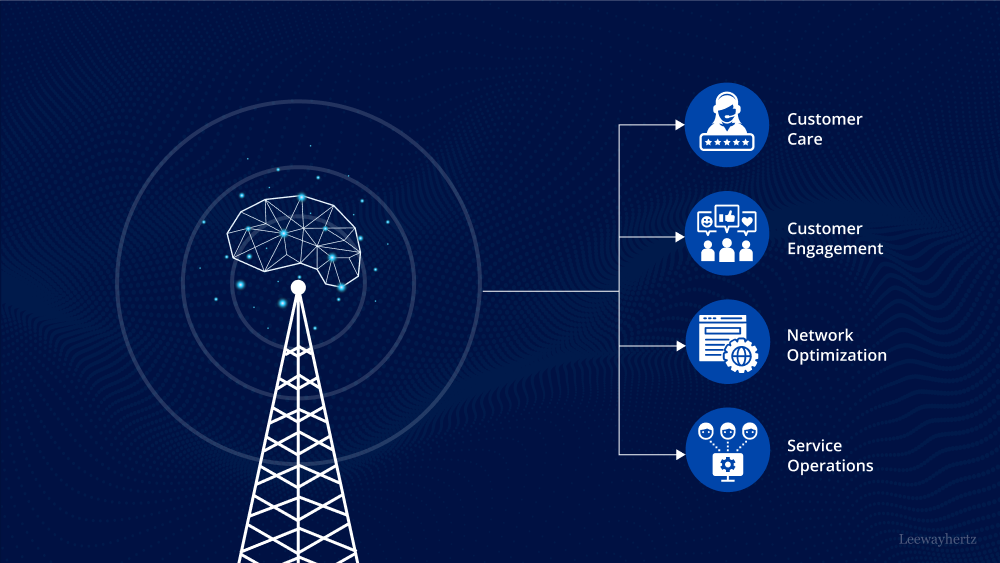


Case Study: How We Used Generative AI for Telecom Network Optimisation

Case Study: How We Used Generative AI for Telecom Network Optimization

The Challenge:

A prominent telecom provider was grappling with two critical issues: inefficient network performance leading to customer dissatisfaction and escalating maintenance costs. Their traditional methods of network management, which relied heavily on historical data and manual adjustments, were proving inadequate in the face of dynamic traffic patterns and the ever-increasing complexity of their infrastructure. This resulted in:

  • Suboptimal Resource Utilization: Network resources (bandwidth, spectrum, hardware) were often underutilized in some areas while being overstretched in others, leading to bottlenecks and degraded service quality.
  • Reactive Maintenance: Issues were typically addressed after they occurred, leading to downtime and costly emergency repairs.
  • Lack of Predictive Capability: Without a robust way to anticipate future network demands, proactive optimization was difficult, if not impossible.

The Solution: Embracing Generative AI

Recognizing the limitations of their existing approach, the telecom company decided to explore the potential of generative AI. Their goal was to move from a reactive to a proactive network management strategy. They implemented a system that incorporated generative AI algorithms, specifically focusing on:

  1. Predicting Traffic Patterns:
    • Data Collection: A vast amount of historical and real-time network data was collected, including call data records, data usage, device types, location information, time of day, and even external factors like public events or weather patterns.
    • Generative Adversarial Networks (GANs) and Variational Autoencoders (VAEs): These generative AI models were trained on this extensive dataset. Unlike traditional predictive models that simply forecast a single value, GANs and VAEs could learn the underlying distribution of network traffic and generate synthetic but realistic traffic scenarios. This allowed the system to understand not just what traffic looked like, but also how it could evolve under various conditions.
    • Probabilistic Forecasting: By generating multiple plausible future traffic scenarios, the AI could provide probabilistic forecasts, giving the company a more comprehensive understanding of potential peak loads and quiet periods.
  2. Optimizing Resource Allocation:
    • Reinforcement Learning (RL): The generative AI’s traffic predictions were then fed into a reinforcement learning framework. The RL agent was trained to make optimal decisions regarding resource allocation (e.g., dynamically adjusting bandwidth, reconfiguring cell towers, allocating virtual network functions) to maximize network performance and minimize operational costs.
    • Simulation Environment: A digital twin of the network was created, allowing the RL agent to experiment with different allocation strategies in a simulated environment without impacting the live network. The generative AI’s ability to create diverse traffic scenarios was crucial here, enabling the RL agent to train on a wide range of realistic conditions.
    • Automated Adjustments: Based on the optimized strategies learned through RL, the system could then recommend or even automatically implement real-time adjustments to network configurations.

The Results: Significant Savings and Improved Performance

The implementation of generative AI yielded remarkable results for the telecom company:

  • 15% Reduction in Operational Costs: By precisely predicting traffic and optimizing resource allocation, the company significantly reduced energy consumption, minimized the need for expensive hardware upgrades, and streamlined maintenance schedules. Resources were utilized more efficiently, leading to less waste.
  • Improved Network Performance: Proactive optimization led to fewer network bottlenecks, reduced latency, and higher data speeds for customers, translating to a noticeable improvement in overall service quality and customer satisfaction.
  • Enhanced Predictive Maintenance: The ability to predict future network stress points allowed for scheduled, preventive maintenance rather than reactive repairs, further reducing costs and downtime.
  • Agility and Scalability: The AI-powered system provided the agility to adapt quickly to changing network demands and the scalability to manage future network growth more effectively.

Key Takeaways:

This case study demonstrates the transformative power of generative AI in the telecommunications sector. By moving beyond traditional analytics to generate insights and scenarios, companies can achieve unprecedented levels of network optimization. The ability to predict, simulate, and proactively adjust network resources based on intelligent, AI-driven foresight is a game-changer for enhancing efficiency, reducing costs, and ultimately, delivering a superior customer experience.

Generative AI is not just about creating content; it’s about creating a more intelligent, efficient, and resilient future for our critical infrastructures.

The Rise of Intelligent Automation: AI’s Role in Streamlining Mobile App Workflows

The Rise of Intelligent Automation: AI's Role in Streamlining Mobile App Workflows

In the fast-paced world of mobile application development, speed, efficiency, and quality are paramount. Developers and businesses are constantly seeking ways to accelerate their processes, minimize errors, and deliver exceptional user experiences. Enter intelligent automation, powered by Artificial Intelligence (AI), which is rapidly transforming how mobile apps are designed, built, tested, and deployed. It’s no longer just a buzzword; AI is the silent force behind today’s most successful apps, streamlining workflows and pushing the boundaries of what’s possible.

What is Intelligent Automation in Mobile App Development?

Intelligent automation in mobile app development is the strategic integration of AI, machine learning (ML), and robotic process automation (RPA) to automate complex and repetitive tasks across the entire development lifecycle. Unlike traditional, rules-based automation, AI-driven systems can learn, adapt, and make intelligent decisions, leading to more dynamic and adaptive development processes.

AI’s Impact Across the Mobile App Development Lifecycle:

AI is reshaping every phase of mobile app creation, from the initial concept to post-deployment maintenance:

  • Auto Code Generation and Optimization: AI-powered tools are now capable of generating code snippets and optimizing existing code for performance and efficiency. Tools like GitHub Copilot translate natural language into functional code, drastically reducing the time spent on repetitive coding tasks and improving overall code quality. This translates to accelerated timelines and more scalable app architectures from day one.
  • Enhanced Code Quality and Review: AI-based code review tools are becoming indispensable. They maintain coding standards, spot logical inconsistencies, detect anti-patterns, and suggest improvements in real-time. This not only fosters better collaboration within development teams but also ensures a cleaner, more reliable final product.
  • Proactive Error Detection and Handling: AI algorithms can now detect both hard and “soft” errors (issues that degrade user experience without crashing the app) even before the code reaches production. Machine learning models predict which parts of the application are prone to breakage, enabling proactive error handling and significantly improving app reliability and user satisfaction.
  • Real-Time User Feedback Loops: AI can collect and interpret user behavior data in real-time, providing invaluable insights into what features users love, what confuses them, and what needs improvement. This data-driven approach removes the guesswork from UX design, allowing developers to create apps that continuously learn and evolve based on actual user habits.
  • Smarter DevOps and Deployment: AI significantly enhances DevOps by automating tasks within CI/CD pipelines. It can predict deployment failures, optimize infrastructure usage, and even recommend the best time for app releases based on traffic data. This leads to fewer downtimes and smoother, more efficient rollouts.
  • Fortified Security: Beyond functionality, AI plays a vital role in mobile app security. It helps in detecting anomalies in user behavior, preventing data leaks by identifying suspicious access patterns, and even auto-patching vulnerabilities through machine learning. Biometric-based authentication mechanisms are also enhanced by AI, critical for sensitive applications like fintech and healthcare.

Key Benefits of AI-Powered Automation:

The integration of intelligent automation into mobile app workflows offers a multitude of benefits:

  • Increased Efficiency and Productivity: By automating repetitive and mundane tasks, AI frees up developers to focus on more strategic, creative, and high-value activities. This leads to faster development cycles and quicker time-to-market.
  • Reduced Costs: Automating tasks minimizes manual intervention, leading to significant reductions in labor costs and error-related expenses.
  • Enhanced Accuracy and Quality: AI-driven processes are less prone to human error, resulting in more consistent and higher-quality applications.
  • Improved Scalability: AI-powered workflows can easily scale to handle increased demands without requiring proportional increases in resources, making them highly adaptable to growth.
  • Personalized User Experiences: AI enables hyper-personalization by analyzing user data and behavior, allowing apps to tailor content, recommendations, and interfaces, leading to higher user satisfaction and engagement.
  • Faster Decision-Making: Real-time data analysis and predictive modeling by AI empower faster, more informed decision-making throughout the development process.

The Future is Intelligent:

The rise of intelligent automation is not just a trend; it’s a fundamental shift in how mobile apps are built and experienced. As AI continues to evolve, we can expect even more sophisticated functionalities:

  • Hyper-personalized workflows: AI will personalize development workflows based on individual developer needs, increasing engagement and productivity.
  • Predictive workflow optimization: Systems will anticipate disruptions and bottlenecks in the development pipeline before they occur, allowing for proactive adjustments.
  • More advanced conversational AI: Natural Language Processing (NLP) advancements will lead to even more intuitive and powerful AI assistants within development environments, simplifying complex tasks through natural language commands.
  • Seamless integration with emerging technologies: AI in mobile apps will seamlessly integrate with IoT, AR, and VR, creating even more immersive and interconnected user environments.

The journey into this smart, user-centered app landscape is just beginning. By embracing intelligent automation, mobile app development teams can push boundaries, unlock new possibilities, and create applications that are not just tools, but intuitive companions that understand and adapt to our needs. The future of mobile apps is undoubtedly intelligent, and the possibilities are as vast as our imaginations.

The “Prompt Engineer” Consultant: Guiding Businesses to Master Generative AI Outputs

ai development company in new york , ai developer in new york , artificial intelligence development company in new york , ai development services in new york , ai development companies in new york

Generative AI is no longer a futuristic concept; it’s a powerful tool transforming how businesses create, innovate, and interact. From crafting marketing copy and generating code to designing compelling visuals and streamlining customer support, Large Language Models (LLMs) and other generative AI systems are unlocking unprecedented efficiencies. But with great power comes the need for precise guidance. This is where the “Prompt Engineer” Consultant emerges as an invaluable asset, helping businesses truly master the art and science of generative AI outputs.

What is Prompt Engineering, and Why Does it Matter?

At its core, prompt engineering is the art and science of designing and optimizing the input (the “prompt”) given to an AI model to elicit the desired output. Think of it as speaking the AI’s language. A vague instruction will lead to a vague or irrelevant response. A well-crafted, nuanced prompt, however, can unlock the AI’s full potential, leading to accurate, relevant, and high-quality results.

For businesses, the stakes are high. Inconsistent or poor AI outputs can lead to:

  • Wasted time and resources: Constant revisions and corrections negate the efficiency gains AI promises.
  • Subpar content: Generic or inaccurate outputs damage brand reputation and user engagement.
  • Missed opportunities: The inability to leverage AI effectively means falling behind competitors.
  • Ethical concerns: Biased or inappropriate AI-generated content can lead to serious repercussions.

This is precisely why the role of a Prompt Engineer, especially in a consulting capacity, has become critical.

The Role of a Prompt Engineer Consultant

A Prompt Engineer Consultant acts as the bridge between a business’s objectives and the capabilities of generative AI. They are more than just wordsmiths; they possess a unique blend of linguistic expertise, technical understanding of AI models, and deep business acumen. Their responsibilities often include:

  1. Strategic Assessment and Goal Alignment: They begin by understanding a business’s specific needs, pain points, and strategic goals. This involves identifying areas where generative AI can provide the most value, whether it’s content creation, customer service automation, data analysis, or product design.
  2. Custom Prompt Development: This is their core competency. They craft tailored prompts that go beyond simple commands, incorporating techniques like:
    • Zero-shot prompting: Guiding the AI to perform a task it hasn’t been explicitly trained on.
    • Few-shot prompting: Providing examples to clarify expectations and guide the AI.
    • Chain-of-thought prompting: Breaking down complex tasks into sequential steps for the AI to follow.
    • Role-playing: Assigning a specific persona to the AI to influence its tone and style.
  3. Iterative Testing and Optimization: Prompt engineering is rarely a one-shot process. Consultants continuously test and refine prompts, analyzing the AI’s outputs, identifying areas for improvement, and iterating until the desired quality and consistency are achieved. This involves understanding the nuances of different AI models (e.g., GPT-4 vs. Google Gemini) and their respective strengths.
  4. Building Prompt Libraries and Frameworks: To ensure scalability and consistent application of AI across an organization, consultants help build comprehensive libraries of successful prompts and robust frameworks for prompt design. This empowers internal teams to leverage AI effectively even without deep prompt engineering expertise.
  5. Workflow Integration and Automation: They advise on how to seamlessly integrate AI-generated outputs into existing business workflows and applications, automating repetitive tasks and enhancing productivity.
  6. Training and Upskilling Internal Teams: A key aspect of a consultant’s role is knowledge transfer. They train internal teams on prompt engineering best practices, empowering employees to become proficient in interacting with AI tools.
  7. Ethical Oversight and Bias Mitigation: Recognizing the potential for AI to generate biased or unethical content, prompt engineers actively monitor outputs and refine prompts to ensure fairness, cultural sensitivity, and alignment with ethical guidelines.
  8. Staying Ahead of the Curve: The AI landscape is constantly evolving. Consultants remain abreast of the latest advancements in AI models, prompting techniques, and industry trends to provide cutting-edge solutions.

Why Businesses Need a Prompt Engineer Consultant

While generative AI tools are increasingly accessible, extracting maximum value requires specialized expertise. A Prompt Engineer Consultant brings:

  • Accelerated Adoption: They help businesses quickly move beyond experimentation to effective implementation of AI.
  • Optimized ROI: By ensuring high-quality, relevant outputs, they maximize the return on investment in AI technologies.
  • Reduced Risk: Their expertise in ethical considerations and bias mitigation helps businesses avoid potential pitfalls.
  • Competitive Advantage: Businesses that master AI outputs can innovate faster, personalize experiences, and gain a significant edge.
  • Empowered Workforce: By enabling employees to effectively use AI, they foster a more productive and innovative work environment.

In an era where generative AI is becoming as fundamental as the internet, the Prompt Engineer Consultant is quickly becoming indispensable. They are the navigators guiding businesses through the complexities of AI, ensuring that the incredible power of these tools is harnessed not just for output, but for impactful, intelligent, and truly transformative outcomes. If your business is looking to unlock the full potential of generative AI, a prompt engineer consultant might just be the guiding hand you need.