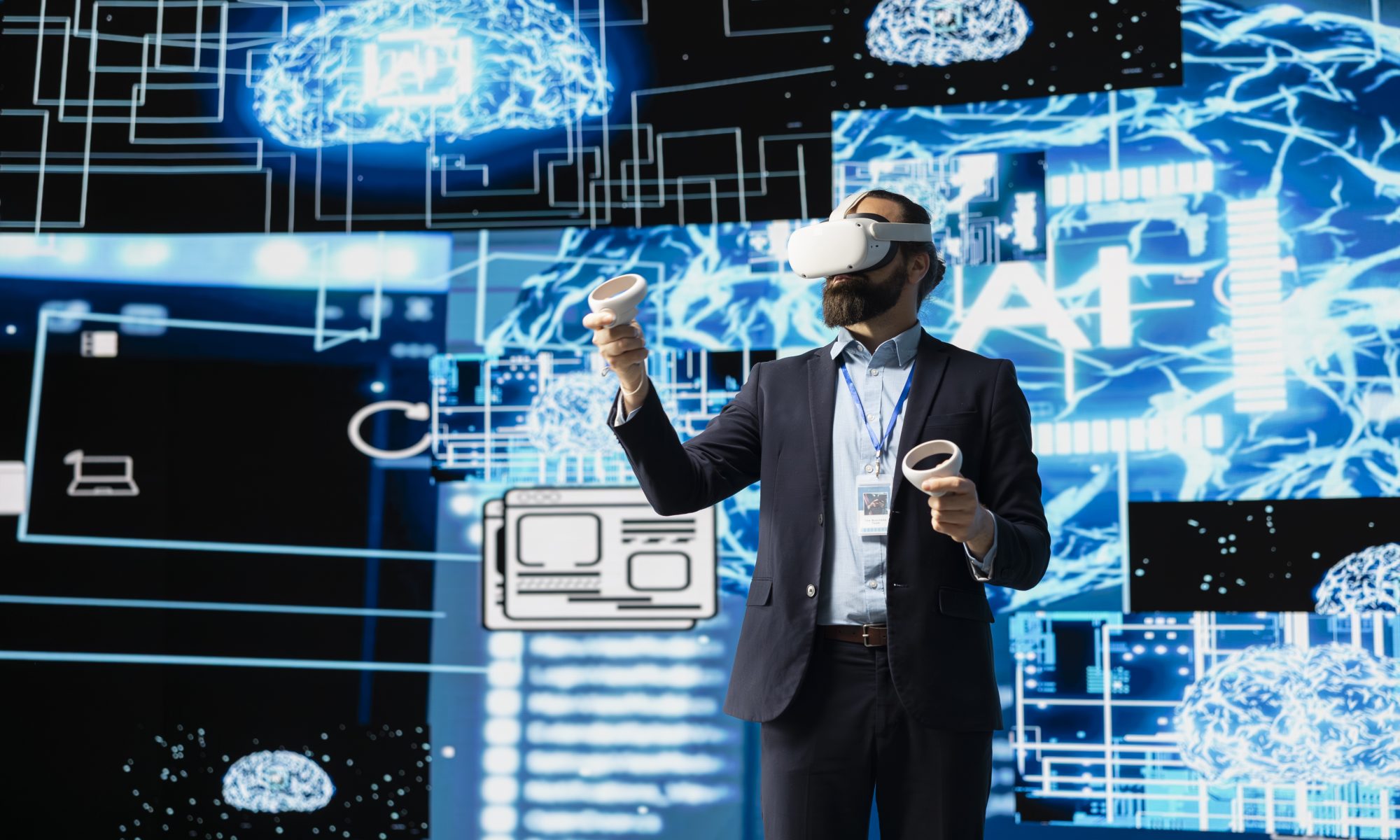


AI Development Company in Dubai | Why Businesses Are Investing Heavily in Artificial Intelligence 2025

AI Development Company in Dubai | Why Businesses Are Investing Heavily in Artificial Intelligence 2025

In 2025, every business that wants to stay ahead is paying close attention to what AI development companies in Dubai are doing. Automation, predictive analytics, smart solutions — these aren’t just buzzwords anymore. They’re changing how entire industries work. If you want your business to run smoother, cut down on wasted time, and grow faster in this digital age, teaming up with the right AI experts in Dubai just makes sense.

  1. Why AI Matters More Than Ever in Dubai

Dubai isn’t just talking about innovation — it’s living it. This city has staked its claim as a leader in artificial intelligence, and you can see it across everything: healthcare, finance, real estate, you name it. Companies here use AI to build smarter, faster systems. By working with an AI development company in Dubai, businesses are weaving machine learning and automation into their day-to-day work and opening doors they didn’t even know existed a few years ago.

  1. Why Businesses Are Turning to AI Companies

There’s a real push toward AI development in Dubai. Companies see how much intelligent solutions help — not just with productivity, but with keeping customers happy. Here’s where they’re putting their money right now:

  • Predictive analytics to actually let data drive decisions
  • Chatbots and virtual assistants for quick, 24/7 customer support
  • Automation that finally gets rid of all those repetitive manual chores
  • Machine learning for serious forecasting power

A good AI developer in Dubai won’t just hand you a one-size-fits-all solution. They’ll listen, get what you’re trying to achieve, and build something that fits your business — and matches Dubai’s big, bold vision for innovation.

  1. What AI Developers Really Do for Business

So what’s the real value of an AI developer in Dubai? They go way beyond coding. These folks design systems that learn, adapt, and actually solve problems as they come up. Maybe you want to automate boring tasks or dig deeper into analytics. Either way, the right AI partner can help you unlock the full potential of this technology. That’s how companies start leading their industries instead of playing catch-up.

  1. How to Pick the Right AI Development Company in Dubai

Choosing the best AI partner isn’t just about flashy portfolios. You want a team that:

  • Handles the whole process, start to finish
  • Builds solutions you can scale up later
  • Knows Dubai’s market and all the local rules
  • Delivers AI that actually lines up with your business goals

Work with a company that checks all these boxes, and you’ll end up with AI solutions that last and grow with you.

  1. What’s Next for AI in Dubai?

Dubai’s future with AI looks huge. The UAE government keeps doubling down on digital transformation, and AI startups are popping up everywhere. If you partner with the right AI development company now, your business is set to ride the next wave of innovation — instead of being left behind.

Conclusion

Dubai’s racing toward a tech-powered future, and any business that wants to keep up needs to get on board. Working with an AI development company in Dubai isn’t just smart — it’s necessary. With the right team on your side, you’ll stay ahead of the competition, run more efficiently, and deliver better experiences to your customers for years to come.

The Difference Between AI | Machine Learning and Deep Learning

The Difference Between AI, Machine Learning, and Deep Learning

Artificial Intelligence (AI) has become one of the most talked-about topics in technology today. From self-driving cars and voice assistants to personalized recommendations on streaming platforms, AI is powering innovations that touch almost every part of our lives. But while the term AI is often used as a catch-all, it’s important to understand the distinctions between Artificial Intelligence (AI)Machine Learning (ML), and Deep Learning (DL).

These three terms are related, but they don’t mean the same thing. Think of them as layers of a hierarchy—where AI is the broad concept, ML is a subset of AI, and DL is a further subset of ML. Let’s break it down.


1. Artificial Intelligence (AI): The Big Picture

Artificial Intelligence refers to the broad field of computer science focused on building systems capable of performing tasks that typically require human intelligence. These tasks include reasoning, problem-solving, learning, perception, and even creativity.

AI can be classified into two main types:

  • Narrow AI (Weak AI): AI systems designed to perform a specific task, such as language translation or playing chess. Examples include Siri, Alexa, and Google Maps.
  • General AI (Strong AI): A theoretical form of AI that could perform any intellectual task a human can do. This is still in the realm of research and speculation.

Key Characteristics of AI:

  • Mimics human intelligence.
  • Can be rule-based (without learning from data).
  • Covers a wide range of applications, from robotics to natural language processing.

Example: An AI-powered chatbot programmed to answer questions using predefined rules and limited decision-making.


2. Machine Learning (ML): Teaching Machines from Data

Machine Learning is a subset of AI focused on enabling machines to learn from data and improve their performance over time without being explicitly programmed. Instead of writing rules manually, developers feed ML algorithms with data, and the system identifies patterns to make predictions or decisions.

Types of Machine Learning:

  1. Supervised Learning: Algorithms learn from labeled datasets (input-output pairs). Example: Predicting house prices based on features like location and size.
  2. Unsupervised Learning: Algorithms work with unlabeled data to find hidden patterns. Example: Customer segmentation in marketing.
  3. Reinforcement Learning: Algorithms learn by interacting with an environment and receiving feedback in the form of rewards or penalties. Example: Training robots to walk.

Key Characteristics of ML:

  • Relies on data-driven models.
  • Focuses on prediction and pattern recognition.
  • Requires less human intervention once trained.

Example: Netflix recommending shows based on your viewing history.


3. Deep Learning (DL): Inspired by the Human Brain

Deep Learning is a subset of machine learning that uses artificial neural networks to mimic the way the human brain processes information. These networks have multiple layers (hence the term “deep”) that allow them to learn complex patterns in large datasets.

Deep learning has been responsible for some of the most impressive breakthroughs in AI, such as image recognition, speech recognition, and natural language understanding.

Key Characteristics of DL:

  • Uses neural networks with multiple layers.
  • Requires massive amounts of data and computational power.
  • Excels at tasks like computer vision, voice assistants, and autonomous driving.

Example: A self-driving car detecting pedestrians, traffic signals, and other vehicles using deep neural networks.


4. The Relationship Between AI, ML, and DL

Here’s a simple way to visualize their relationship:

  • AI is the umbrella term—the overall concept of creating smart machines.
  • ML is a subset of AI that allows systems to learn from data.
  • DL is a further subset of ML that uses advanced neural networks for more complex tasks.

Think of it like this:

  • AI = The entire universe of intelligent systems.
  • ML = A planet within that universe, where data-driven learning happens.
  • DL = A continent on that planet, specialized in solving highly complex problems using neural networks.

5. Real-World Examples to Illustrate the Difference

  • AI Example: A chess program that follows hardcoded rules to beat human players.
  • ML Example: Spam filters that improve over time by learning from emails marked as spam or not spam.
  • DL Example: Google Photos automatically recognizing faces and grouping them together.

6. Why Does This Distinction Matter?

Understanding the difference between AI, ML, and DL is crucial for businesses, professionals, and everyday users because:

  • It helps set realistic expectations about what technology can and cannot do.
  • It clarifies what resources (data, computing power, expertise) are needed for different solutions.
  • It avoids confusion when discussing trends, capabilities, and future directions in tech.

Conclusion

Artificial Intelligence, Machine Learning, and Deep Learning are deeply connected, but they’re not interchangeable terms. AI is the big idea, aiming to make machines act intelligently. ML is one way to achieve AI, by letting machines learn from data. DL takes ML further, using complex neural networks to solve tasks once thought impossible for machines.

As technology advances, these fields will continue to overlap, evolve, and fuel innovations that shape the future of how we live and work.

Top Everyday Examples of AI You’re Already Using Without Realizing

Top Everyday Examples of AI You’re Already Using Without Realizing

Artificial Intelligence (AI) might sound futuristic or limited to tech companies, but the truth is—you’re surrounded by it every single day. From the moment you wake up to the time you go to bed, AI quietly powers many of the apps, devices, and services you depend on. The best part? Most of the time, you don’t even realize it’s there.

In this blog, let’s uncover some everyday examples of AI you’re already using—sometimes without even noticing.


1. Your Smartphone Assistant

Whether you use Siri, Google Assistant, or Alexa, you’re interacting with AI daily. These voice assistants rely on natural language processing (NLP) and machine learning to understand your commands, answer questions, and even anticipate your needs.

  • Setting alarms by voice
  • Getting directions
  • Asking for weather updates
  • Sending quick texts hands-free

All of this is possible because of AI.


2. Social Media Feeds

Ever wondered why your Instagram, Facebook, or TikTok feed feels like it “knows” you? That’s AI in action. Platforms use AI algorithms to analyze your behavior—what you like, comment on, or skip—and then curate content that keeps you engaged.

  • TikTok’s “For You” page is AI-powered
  • Instagram shows posts based on your interests
  • Facebook recommends friends and groups using AI

In short, your social media scrolling experience is custom-built by AI.


3. Email Filters & Smart Replies

If Gmail automatically pushes certain emails into your Spam or “Promotions” folder, that’s AI doing the heavy lifting. Similarly, those short “smart replies” like “Got it” or “Let’s talk tomorrow” are generated by AI to save you time.

  • AI spam filters protect you from phishing and junk mail
  • Predictive text makes email writing faster
  • Prioritization ensures important emails stand out

4. Navigation & Ride-Sharing Apps

Google Maps, Apple Maps, and ride-hailing services like Uber and Ola use AI in multiple ways:

  • Predicting the fastest route based on traffic data
  • Estimating arrival times
  • Matching drivers with passengers in real-time

Behind every smooth trip you take, AI is crunching data to make transportation seamless.


5. Streaming Recommendations

When Netflix recommends a show you end up binge-watching, or when Spotify creates your perfect playlist, that’s AI at work. These platforms rely on recommendation engines powered by AI, analyzing your history and comparing it with others to suggest exactly what you might enjoy next.


6. E-Commerce & Online Shopping

AI has transformed how you shop online:

  • Personalized product recommendations on Amazon or Flipkart
  • “Frequently Bought Together” and “Customers Also Viewed” suggestions
  • AI-powered chatbots that answer queries instantly

It feels effortless, but AI is constantly learning your preferences to make shopping smoother.


7. Smart Home Devices

From smart speakers like Amazon Echo to smart bulbs, thermostats, and even robotic vacuum cleaners—AI is embedded in modern households. These devices learn your routines and adjust settings automatically, such as:

  • Turning on lights when you arrive
  • Adjusting temperature based on time of day
  • Cleaning your house while you’re at work

8. Banking & Fraud Detection

Every time your bank sends you an alert about “suspicious activity,” AI is behind it. Banks use AI-powered fraud detection systems to analyze millions of transactions in real-time, spotting unusual patterns that humans could easily miss.


9. Online Search Engines

Google search isn’t just a simple query box—it’s one of the most advanced AI systems in the world. AI ensures you get the most relevant results, powers voice search, and even predicts what you’re about to type through autocompletesuggestions.


10. Photo & Face Recognition

When your phone unlocks with Face ID, or Google Photos creates an album of your friend’s pictures automatically, you’re witnessing AI in computer vision. AI can detect objects, identify people, and even enhance image quality without your input.


11. Customer Service Chatbots

The next time you ask a company a question online and get an instant response, you’re likely talking to an AI-powered chatbot. These virtual assistants are designed to handle FAQs, book appointments, and even process orders—all without human intervention.


12. Predictive Text & Autocorrect

While texting, have you noticed how your phone suggests the next word, or fixes typos instantly? That’s AI working behind the scenes with predictive modeling and language learning to make communication faster and easier.


Final Thoughts

AI isn’t just about futuristic robots or self-driving cars—it’s woven into the fabric of your everyday life. From the music you enjoy to the routes you drive, the emails you send to the photos you save—AI is always working quietly in the background.

The next time you pick up your smartphone or open your laptop, remember—you’re already living with AI. And as the technology advances, its presence in your daily routine will only grow stronger.