
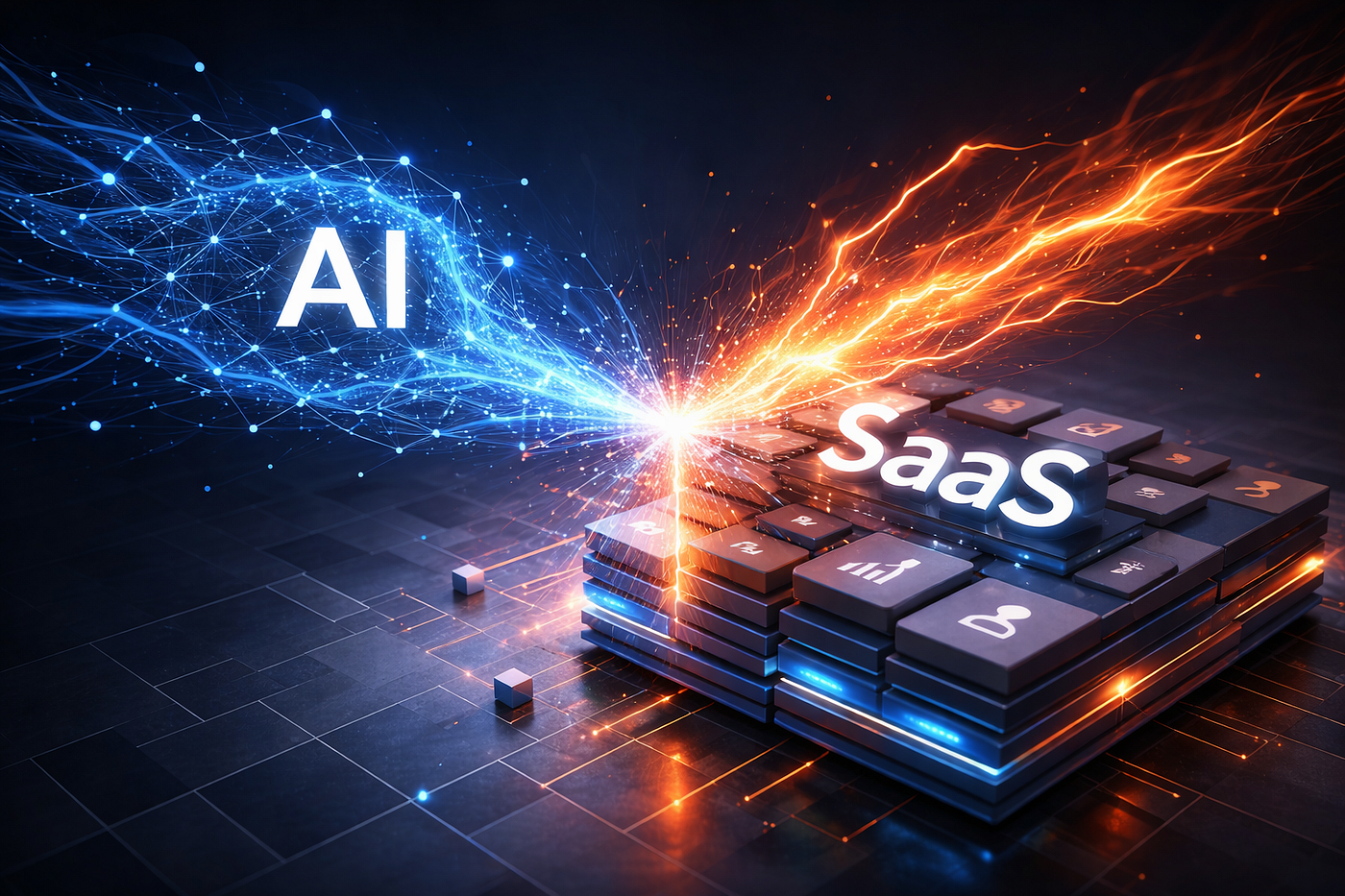
For the last couple of years, one claim has shown up again and again in tech conversations: AI is killing SaaS. It sounds bold, disruptive, and attention-grabbing. But when you look at how businesses actually buy, deploy, and scale software, that statement falls apart quickly.
The reality is much more practical.
AI is not killing SaaS. AI is reshaping SaaS, strengthening SaaS, and pushing SaaS products to evolve faster. Instead of replacing software-as-a-service platforms, artificial intelligence is making them smarter, more adaptive, and more valuable to end users. In many cases, AI is becoming a layer inside SaaS products, not a substitute for them.
For companies exploring digital transformation, this distinction matters. Business leaders do not need less software because AI exists. They need better software, more intelligent workflows, and systems that reduce manual effort while improving outcomes. That is exactly why demand continues to grow for every capable AI development company in New York, that can help businesses build practical AI-powered platforms.
In this blog, we will break down why the “AI kills SaaS” narrative is misleading, what is actually happening in the market, and why the future belongs to businesses that combine SaaS with AI in the right way.
The Origin of the “AI Will Kill SaaS” Narrative
This myth comes from a simple but flawed assumption: if AI can answer questions, generate content, automate tasks, and assist decision-making, then businesses will no longer need traditional software platforms.
At first glance, that idea seems reasonable. If a user can simply ask an AI assistant to generate reports, summarize data, create workflows, or even write code, then why would they need dozens of software subscriptions?
Because businesses do not run on prompts alone.
Organizations depend on systems that provide structure, permissions, integrations, recordkeeping, security, dashboards, billing, analytics, approvals, compliance, customer data, and repeatable workflows. SaaS platforms do all of that. AI may enhance the experience, but it does not remove the need for the system itself.
A chatbot can draft a sales email. A CRM platform stores the lead history, tracks pipeline stages, assigns follow-ups, integrates with communication channels, and helps leadership forecast revenue. AI can summarize support tickets. A customer service SaaS platform manages queues, SLAs, role access, reporting, and resolution history.
That is the difference many headline-level takes ignore.
AI is excellent at intelligence and assistance. SaaS is essential for operational structure. Modern businesses need both.
AI Does Not Replace SaaS. It Makes SaaS Better.
The strongest argument against the “AI kills SaaS” theory is visible in the market itself. The most successful software platforms are not disappearing because of AI. They are adding AI features to become more useful.
That is because AI works best when it is connected to real business systems. It becomes more valuable when it has context: customer records, internal knowledge, transaction histories, operational data, and process rules. SaaS platforms already hold that context.
Without a system of record, AI becomes generic.
Without business logic, AI becomes inconsistent.
Without integrations, AI becomes isolated.
Without governance, AI becomes risky.
SaaS products solve those problems. AI adds speed, prediction, personalization, and automation on top of them.
This is why businesses increasingly look for ai development services in New York that do more than build standalone AI models. They want AI embedded into products, portals, enterprise systems, mobile apps, and customer-facing workflows. They want usable intelligence, not disconnected experiments.
Why Businesses Still Need SaaS in an AI-First World
1. Businesses Need Systems, Not Just Intelligence
AI can interpret, generate, and recommend. But businesses need platforms that execute reliably.
A finance team needs approval workflows, audit trails, ledger management, and role-based access. A healthcare company needs secure records, compliance support, and integration across systems. A logistics business needs delivery tracking, user permissions, notifications, and dashboards. These are not just “AI tasks.” These are platform requirements.
SaaS remains the operating model that organizes and delivers these capabilities consistently.
2. Data Has to Live Somewhere Trusted
AI is only as good as the data it can access. But that data needs to be structured, secured, and maintained somewhere. SaaS applications provide that trusted environment.
Whether it is a CRM, ERP, HRMS, project management platform, or industry-specific solution, SaaS products serve as the data backbone. AI relies on those systems to function meaningfully.
3. Compliance, Security, and Governance Matter More Than Ever
Many businesses cannot simply replace their software stack with a general AI layer. They operate in regulated industries or under strict internal controls. They need access logs, user permissions, policy enforcement, workflow approvals, and governance models.
SaaS platforms are designed for those realities. AI alone does not automatically solve them.
4. Repeatability Is Still the Core of Business Software
Businesses do not only want smart answers. They want repeatable outcomes.
They need onboarding processes, invoicing flows, support resolution paths, procurement cycles, employee management systems, and customer lifecycle tracking. SaaS products provide repeatable frameworks. AI helps optimize those frameworks, but does not eliminate the need for them.
What AI Is Actually Doing to SaaS
Rather than killing SaaS, AI is forcing SaaS companies to improve in five major ways.
Smarter User Experiences
AI is making software easier to use. Instead of navigating complex menus and dashboards, users can now ask natural-language questions, generate reports, automate actions, or receive recommendations inside the platform.
This lowers the learning curve and improves productivity.
Better Automation
Many SaaS tools previously depended on manual configurations and rule-based automations. AI introduces more flexible automation. It can classify tickets, prioritize tasks, generate workflows, score leads, detect anomalies, and personalize responses.
Higher Product Expectations
Users now expect software to do more than store data. They expect it to assist them. SaaS companies that ignore AI risk feeling outdated. But that does not mean SaaS disappears. It means the standard rises.
More Verticalization
AI is enabling software providers to build more specialized tools for industries such as healthcare, finance, logistics, real estate, legal, and manufacturing. Vertical SaaS becomes even stronger when combined with domain-aware AI.
Platform Consolidation With Intelligence
In some cases, AI helps reduce tool sprawl by making broader platforms more capable. That still is not the death of SaaS. It is the evolution of SaaS into more intelligent ecosystems.
The Real Future: AI-Powered SaaS
The future is not AI versus SaaS.
The future is AI-powered SaaS.
That means software products that include conversational interfaces, workflow automation, predictive insights, personalized recommendations, document intelligence, voice interactions, and smart search. But underneath all of that is still a platform architecture handling data, logic, permissions, and integrations.
This shift is creating strong demand for every capable AI development company in New York and for businesses searching for a skilled AI developer in New York who can move beyond prototypes and build production-ready solutions.
Organizations are no longer asking, “Should we use SaaS or AI?”
They are asking:
- How can we embed AI into our existing platforms?
- How can we build new AI-powered software products?
- How can we automate operations without losing control?
- How can we make customer and employee experiences more intelligent?
Those questions are driving the next generation of product development.
Why the “AI Kills SaaS” Argument Misses the Economics
SaaS exists because it solves a business distribution problem very effectively. It allows companies to deliver software continuously, manage updates centrally, onboard users quickly, and scale across customers without custom deployment for every installation.
AI does not change those economic advantages.
In fact, AI often works better within the SaaS model because cloud-based software makes it easier to:
- deploy AI updates
- improve models over time
- collect usage feedback
- monitor performance
- integrate across services
- maintain centralized governance
From a business perspective, SaaS remains one of the strongest software delivery models. AI enhances its value proposition rather than making it obsolete.
Where the Confusion Comes From
A lot of the confusion comes from mixing up three different things:
1. Some Weak SaaS Products Will Disappear
Yes, some low-value SaaS tools may struggle if they only offer basic features that AI can now replicate or simplify. That does not mean SaaS as a category is dying. It means weak products with poor differentiation are vulnerable.
2. Interfaces Are Changing
Users may not interact with software the same way they did five years ago. Instead of clicking through ten menus, they may use voice, chat, or AI assistants. But the platform behind that experience still exists.
3. AI Can Reduce the Number of Tools
In some cases, AI may help consolidate software categories or reduce dependence on point solutions. But consolidation is not elimination. Businesses still need core systems and managed workflows.
So the smarter framing is this: AI is pressuring SaaS vendors to become more intelligent, more integrated, and more outcome-driven.
Why SaaS Companies Should See AI as an Opportunity
For SaaS founders and product leaders, AI should not be viewed as a threat. It should be treated as a competitive advantage.
When used strategically, AI can help SaaS companies:
- improve customer retention
- create premium features
- reduce churn caused by poor usability
- increase user engagement
- automate support and onboarding
- unlock new revenue streams
- create differentiation in crowded markets
A modern SaaS product with embedded AI becomes harder to replace, not easier.
That is why many businesses are partnering with ai development companies in New York to enhance existing SaaS platforms or launch new AI-native software products that solve real operational problems.
Practical Examples: How AI Strengthens SaaS
CRM Platforms
AI can summarize calls, score leads, draft follow-up emails, predict churn, and recommend next actions. But the CRM remains the system of record.
HR and Recruitment Platforms
AI can screen resumes, suggest job matches, automate candidate communication, and analyze hiring trends. But the HR platform still handles records, workflows, approvals, and compliance.
Healthcare Software
AI can assist with diagnostics support, medical document summarization, and patient communication. But the healthcare platform still manages patient records, access controls, scheduling, and regulatory requirements.
E-commerce SaaS
AI can recommend products, generate descriptions, forecast demand, and personalize customer journeys. But the commerce platform still manages inventory, orders, payments, and fulfillment.
Project Management Tools
AI can generate task summaries, detect risks, recommend timelines, and automate updates. But the platform still organizes projects, teams, resources, and visibility.
In every case, AI adds intelligence. The SaaS platform remains essential.
What Businesses in New York Should Pay Attention To
New York is one of the strongest business ecosystems for digital innovation, from startups and fintech firms to healthcare organizations, logistics providers, professional services companies, and enterprise operators. For these businesses, the question is not whether AI will erase software subscriptions. The real question is how to build better digital infrastructure.
That is why search demand continues to grow around terms like:
- ai development company in new york
- ai developer in new york
- artificial intelligence development company in new york
- ai development services in new york
- ai development companies in new york
Businesses want partners who can help them modernize products, integrate AI into core workflows, and create scalable platforms that deliver measurable value.
They need teams that understand both AI capability and business execution.
What to Look for in an AI Development Partner
If your business is planning to build an AI-powered SaaS platform or upgrade an existing software product, the right development partner matters a lot.
Look for a team that understands:
- product architecture
- data security and governance
- UX design for AI-assisted interfaces
- API integrations
- cloud deployment
- model selection and fine-tuning
- workflow automation
- analytics and ongoing optimization
A strong artificial intelligence development company in New York should not just talk about models and prompts. It should understand how AI fits into real business operations and customer experiences.
The best outcomes come from partners who can bridge software engineering, business logic, and AI implementation.
Why AI-First Software Still Looks Like SaaS
Even when a product is built from the ground up with AI at its center, it still often behaves like SaaS.
Why?
Because businesses still expect:
- monthly or annual subscriptions
- user accounts and permissions
- dashboards and reporting
- ongoing updates
- integrations with other tools
- support and monitoring
- cloud accessibility
- multi-user collaboration
Those are all SaaS characteristics.
So even “AI-native” products are often SaaS products with stronger intelligence layers. That alone should end the idea that AI and SaaS are opposites.
The Better Question: How Will AI Redefine SaaS Value?
Instead of asking whether AI is killing SaaS, businesses should ask a more useful question:
How does AI change what great SaaS looks like?
The answer is clear. Great SaaS in the coming years will be:
- more conversational
- more automated
- more predictive
- more personalized
- more integrated
- more outcome-focused
But it will still be software delivered as a service.
AI changes the experience and the value. It does not eliminate the model.
Conclusion
The idea that AI is killing SaaS makes for a catchy headline, but it does not match how modern software works in the real world.
SaaS is not disappearing. It is evolving.
AI is not replacing business platforms. It is making them more intelligent, more productive, and more competitive. Companies that understand this shift will build stronger digital products, better workflows, and more resilient businesses.
For organizations planning the next stage of growth, the real opportunity lies in combining the reliability of SaaS with the power of AI. That is where transformation happens.
If you are looking to build or upgrade intelligent software, working with an experienced AI development company in New York can help you create practical, secure, and scalable solutions. It should be building software that becomes more valuable because of AI.
That is not the end of SaaS.
That is the next chapter of SaaS.
FAQ’s
No. AI is not killing SaaS. It is improving SaaS by making software more intelligent, automated, and user-friendly. Businesses still need platforms for data management, workflows, security, integrations, and compliance.
In most cases, no. AI may reduce the need for some low-value point tools, but businesses still rely on subscription-based platforms to run operations at scale. AI usually becomes a feature inside software rather than a replacement for it.
This idea comes from the belief that AI assistants can do tasks that many software tools used to handle. But businesses need much more than task completion. They need structured systems, data governance, approvals, reporting, and repeatable workflows.
AI-powered SaaS is software delivered through the cloud that includes AI features such as recommendations, chat interfaces, automation, predictive analytics, smart search, and content generation.
A local and experienced AI development company in New York can help businesses build AI solutions tailored to their workflows, customers, and industry needs. This includes product strategy, AI integration, software development, security, and long-term scalability.
A trusted artificial intelligence development company in New York may offer AI consulting, chatbot development, workflow automation, machine learning solutions, predictive analytics, generative AI integrations, and custom AI-powered application development.
Look for an AI developer in New York or a broader AI team with experience in software engineering, API integrations, cloud deployment, user experience, security, and real business use cases. Technical skill matters, but business understanding matters just as much.
Yes. Many companies use AI development services in New York to improve existing SaaS products by adding automation, smarter analytics, better search, AI assistants, and customer personalization.
Yes. There are many AI development companies in New York, but businesses should look beyond marketing claims and choose a partner with proven implementation capability, domain knowledge, and a clear understanding of how AI creates measurable business value.