
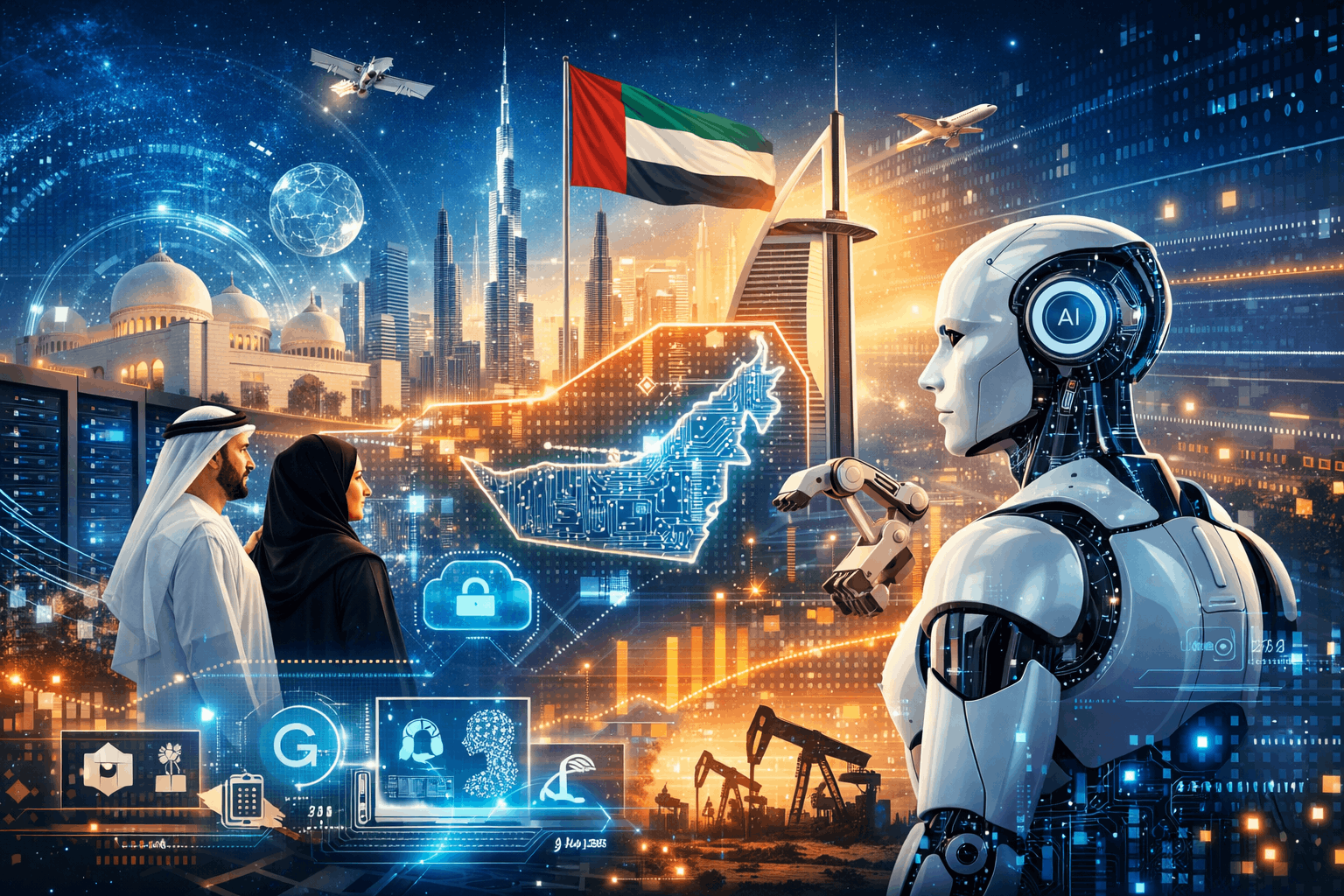
The UAE is engineering one of the most intentional AI-driven economic shifts in the world. Instead of treating AI as a “nice-to-have” innovation layer, the country is building it into national strategy, government operations, talent pipelines, and the hard infrastructure (cloud, data centers, compute access) that makes modern AI viable at scale. The result is a tech economy evolving from “digital transformation” to something more ambitious: an AI-native ecosystem that can create new industries, raise productivity across legacy sectors, and export AI-enabled services globally.
Below is a deep look at how that transformation is unfolding—and what it means for the UAE’s tech economy over the next decade.
1) AI as a national economic strategy, not a side project
Many countries talk about AI leadership; fewer embed it into state capacity, regulation, education, and infrastructure simultaneously. The UAE’s approach is explicitly strategic: using AI to improve government performance, accelerate economic growth, and position the UAE as a global AI destination—aligned with longer-term national visions.
A practical implication of this “AI-first” national posture is speed. When public sector demand is coordinated—through digital government programs, procurement patterns, and sector initiatives—it becomes a predictable market-maker for AI companies. That predictability reduces risk for startups, attracts foreign firms, and helps local champions scale faster.
Just as importantly, it creates a narrative that pulls talent and capital into the region: AI isn’t “one vertical” in the UAE—it is becoming the substrate for the next phase of economic growth.
2) Compute, cloud, and data centers: the “real economy” of AI
AI’s impact is often discussed in terms of apps, chatbots, and automation. But the future of the AI economy is largely determined by infrastructure: access to cloud, energy, GPUs, data governance, and secure platforms for enterprises and government.
The UAE’s data center buildout is turning into a competitive advantage
Recent reporting highlights how the UAE is becoming a regional (and increasingly global) hub for hyperscale data centers and sovereign cloud—driven by AI workloads and enterprise adoption.
This matters because:
- AI workloads need proximity to compute for latency, reliability, and security.
- Cloud region availability influences where companies set up engineering teams and where products can be served.
- Data center capacity is a magnet for adjacent ecosystems: cybersecurity, MLOps, AI governance tooling, and enterprise integration services.
Strategic partnerships are accelerating scale
One of the most consequential moves has been Microsoft’s strategic investment and partnership with Abu Dhabi’s G42, designed to accelerate AI development and deployment using Azure across industries.
Beyond brand value, these partnerships can unlock:
- Enterprise-grade platforms and security practices
- Wider access to cloud-native AI tooling
- Larger-scale skilling and ecosystem funds (including developer enablement initiatives referenced in Microsoft’s partnership notes)
Mega-projects signal an industrial-scale AI ambition
Reuters has reported major data center expansion plans tied to Microsoft and G42, including a 200MW data center capacity expansion via Khazna Data Centers with operations expected to begin by end-2026.
Reuters has also reported on plans for the first 200MW of a larger “Stargate” AI campus in the UAE coming online in 2026 as part of a much bigger buildout vision.
These projects are important not just for the UAE, but for the region: they signal that the UAE intends to be a place where frontier-scale AI can be trained, deployed, and commercialized.
Tech economy takeaway: In the next wave of AI, countries with strong compute + cloud + governance + energy planning become the default destinations for AI-intensive businesses. The UAE is deliberately positioning itself in that group.
3) Government as an AI platform: the rise of “AI-native public services”
A defining feature of the UAE’s AI story is the attempt to make government itself AI-enabled—reducing friction for citizens and businesses, improving decision-making, and modernizing service delivery.
Dubai’s policy push is a clear example. The “Dubai Universal Blueprint for Artificial Intelligence” is designed to accelerate AI adoption and strengthen Dubai’s position as a global hub for AI.
Why this matters economically:
- Faster permitting and licensing can reduce time-to-market for startups and investors.
- Predictable digital public infrastructure (identity, payments, service portals) creates a stable base for innovation.
- Government demand becomes a forcing function for local AI capabilities: language models, document intelligence, workflow automation, fraud detection, and citizen support.
Over time, AI-native government becomes a competitive advantage similar to logistics excellence or business-friendly regulation: it attracts builders who want speed and clarity.
4) Talent and research: turning AI education into economic capacity
AI leadership isn’t just compute—it’s people.
The UAE has invested heavily in building local AI research and training capacity, most visibly through MBZUAI (Mohamed bin Zayed University of Artificial Intelligence), positioned as a dedicated AI-focused university with programs aimed at addressing applied AI skills gaps.
This matters for the tech economy in three ways:
- Human capital compounding: Graduate programs and research labs create a renewable supply of ML engineers, researchers, and product builders.
- Industry collaboration: Universities increasingly act as bridges—pairing research with enterprise and government deployment.
- Attracting global talent: Frontier AI talent is scarce. Dedicated institutes, scholarships, and ambitious national goals can pull talent that might otherwise go only to the US/Europe.
Recent announcements around scholarships and undergraduate AI pathways further reinforce the long-horizon talent strategy.
5) “Sovereign AI” and Arabic-first innovation: a regional differentiator
A core UAE advantage is that it can build AI that is culturally and linguistically tuned to the Arabic-speaking world—while also meeting enterprise demands for privacy, security, and governance.
Arabic LLMs as strategic infrastructure
MBZUAI and G42’s ecosystem has pushed Arabic-language LLM development through the open-source release of Jaisand, more recently, Jais 2.
This is economically significant because Arabic-capable AI is not a “feature”—it can be the foundation for entire sectors:
- AI customer service for government and banking
- Education and tutoring tools aligned to Arabic curricula
- Media, publishing, and localization at scale
- Legal and compliance document intelligence in Arabic
Open models and frontier ambition
Financial Times reporting highlights MBZUAI’s launch of an open-source model (“K2 Think”) positioned as part of a sovereign AI approach, emphasizing transparency and competitiveness.
Tech economy takeaway: The UAE can become the default AI hub for Arabic-first products and services—similar to how some regions dominate fintech, gaming, or semiconductors. Building models and datasets that truly work in Arabic is a defensible moat.
6) Startups, campuses, and innovation zones: where AI becomes a business engine
A tech economy needs density: founders, investors, customers, mentors, and policy. Dubai and Abu Dhabi are building that density through hubs, campuses, and accelerators.
Dubai’s DIFC-linked AI ecosystem efforts—including the Dubai AI and Web3 Campus / Dubai AI Campus—have been positioned to host hundreds of companies and create thousands of jobs by 2028.
This kind of clustering matters because it:
- concentrates specialized talent (MLOps, AI security, data engineering)
- increases deal flow (funding, partnerships, acquisitions)
- enables faster “enterprise meets startup” adoption cycles—critical for B2B AI
Where the real value emerges: Not in “AI as a demo,” but in repeatable enterprise deployments:
- customer support automation integrated into CRM and call centers
- fraud detection and AML improvements in fintech
- supply-chain forecasting for logistics and retail
- predictive maintenance in oil & gas and manufacturing
7) Sector transformation: AI as the productivity layer across the UAE economy
The UAE’s tech economy is not only about creating AI companies. It’s also about making every major sector more productive and globally competitive.
Here are the big lanes where AI tends to move GDP and enterprise value fastest:
Financial services & fintech
- fraud detection, credit risk modeling, personalized banking
- compliance automation (KYC/AML document intelligence)
- conversational AI front doors for customer service
Energy & sustainability
- grid optimization, demand forecasting
- predictive maintenance in industrial environments
- carbon measurement and reporting automation
Logistics, aviation, and ports
- route optimization and predictive ETA
- automated document handling (customs, shipping paperwork)
- warehouse robotics and computer vision for sorting/inspection
Real estate, construction, and smart cities
- permitting automation and planning simulation
- safety monitoring via computer vision
- building energy optimization via AI controls
Healthcare
- radiology support, triage tools, patient journey automation
- claims automation and fraud detection
- hospital operations optimization (staffing, bed management)
Across these sectors, the UAE’s advantage is that it can move from pilot to deployment faster when infrastructure, data policy, and executive sponsorship align.
8) Regulation, trust, and data governance: the foundation for enterprise adoption
AI adoption at national scale requires trust. That trust is built through privacy rules, security practices, and responsible AI governance.
The UAE has established a federal Personal Data Protection Law (PDPL) framework, referenced by the UAE’s official platform in its overview of data protection laws.
(Implementation details and timelines are discussed widely in industry summaries, but for policy positioning, the official UAE platform is the most reliable anchor.)
Why governance drives the tech economy:
- Enterprises adopt AI faster when privacy obligations are clear.
- Cross-border business grows when data protection standards are legible to partners.
- “Sovereign cloud” + data residency capabilities can unlock sensitive workloads (government, finance, healthcare).
The next step for the UAE’s AI economy is not only writing policy—but operationalizing it:
- model risk management standards
- auditability and explainability practices
- procurement requirements for safety/security in high-risk AI use cases
9) What challenges could slow the UAE’s AI tech economy?
Even with strong momentum, there are real constraints the UAE must manage to sustain AI-led growth:
1) Compute access and geopolitical risk
AI chips, export controls, and cross-border dependencies can introduce uncertainty. Reuters reporting underscores how advanced technology access can be shaped by geopolitical considerations.
2) Talent competition
The UAE is competing with Silicon Valley, Europe, and Asia for the same high-end AI talent. Sustained leadership requires:
- more pathways from education → startups → scale-ups
- strong compensation benchmarks
- founder-friendly visa and incorporation processes (where the UAE already has strengths)
3) From pilots to ROI
The world is littered with AI pilots. The winners are ecosystems that can consistently deliver:
- real KPI movement (cost reduction, revenue lift, risk reduction)
- strong data foundations (clean, labeled, accessible)
- change management inside enterprises
4) Trust, privacy, and responsible AI
Scaling AI in government and regulated industries demands “trust by design.” That means robust privacy practice, model governance, and security assurance—especially as AI becomes embedded into citizen-facing services.
10) What the next 5–10 years could look like
If the UAE continues on its current trajectory, several outcomes become plausible:
The UAE becomes an export hub for AI-enabled services
Not only building AI products locally, but exporting implementation capability across MENA, Africa, and South Asia—especially in regulated enterprise contexts (finance, public sector, critical infrastructure).
“Arabic-first AI” becomes a category the UAE leads
With ongoing investment in Arabic datasets and open models, the UAE can dominate Arabic enterprise AI similarly to how other countries lead in specific AI niches (robotics, chips, foundational research).
A flywheel forms between infrastructure, startups, and enterprise adoption
- More data centers → more AI companies move in
- More companies → more demand for specialized talent and services
- More demand → more universities and training programs expand
- More talent → more startups and deeper enterprise deployments
This is how tech economies become durable.
Conclusion: AI is becoming the UAE’s next “economic operating system”
The UAE’s AI strategy is not only about innovation headlines. It is a coordinated attempt to shape the fundamentals of a future tech economy: infrastructure, talent, governance, and real sector transformation. National initiatives, Dubai’s AI blueprint, education investments like MBZUAI, and partnerships such as Microsoft–G42 are building the scaffolding for an AI-native growth model.
The countries that win the AI era won’t necessarily be the ones with the loudest marketing. They’ll be the ones that make AI deployable, governable, and profitable at scale. The UAE is clearly trying to be one of them.